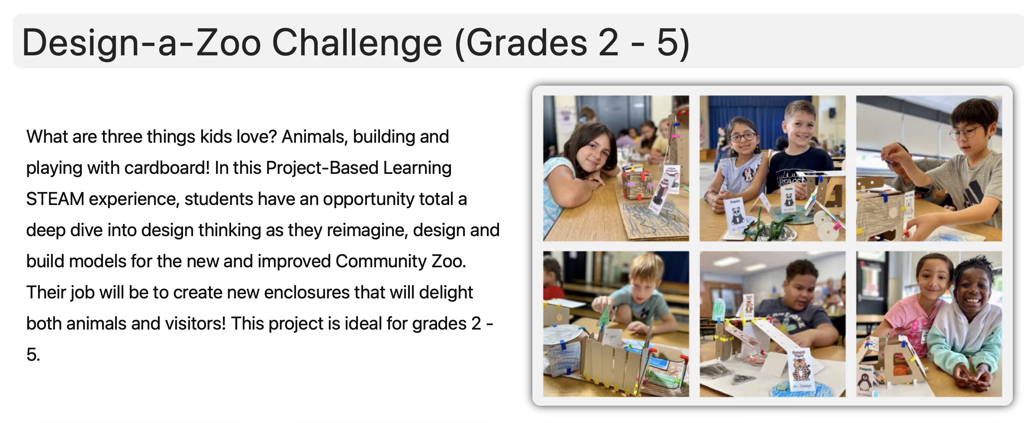
Building Literacy Pathways in the Brain
A modern, science-informed look at reading, dyslexia, and multimodal learning
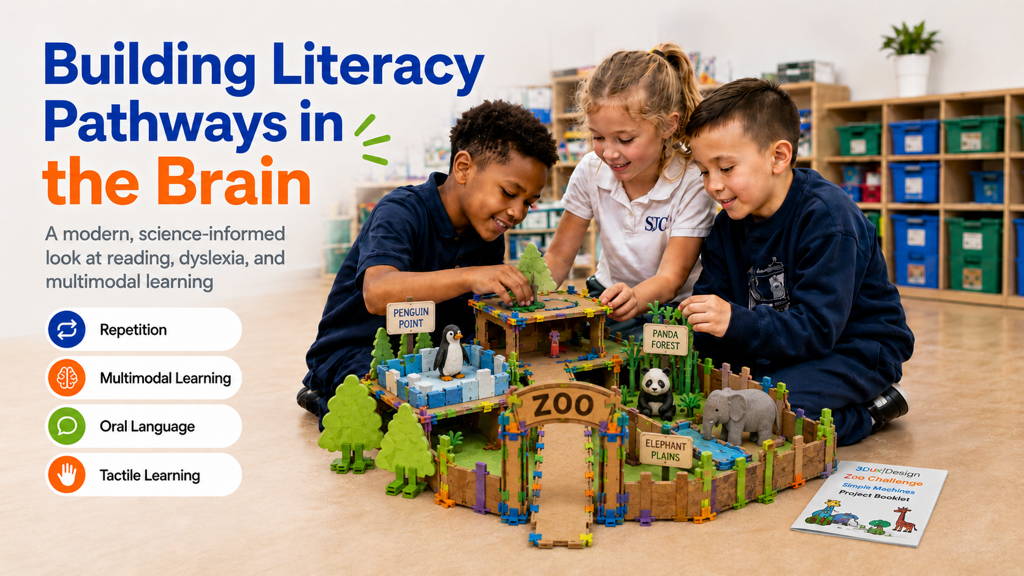
As educators, we know students do not all access learning in the same way. Some students are strong readers. Others think best through talking, building, drawing, listening, moving, or solving problems with their hands. For students with dyslexia and other language-based learning differences, this matters even more. The tools we choose can either narrow the doorway into learning - or widen it.
Brain research is helping us better understand why. When we understand how the reading brain develops, and how it may develop differently for dyslexic learners, we can design learning experiences that give more students meaningful ways to access content, practice language, and show what they know.
The science behind the reading brain
Reading feels automatic for many adults, but biologically, the human brain was not originally built for reading. Unlike spoken language, reading is a relatively recent human invention. To read, the brain has to build a network that connects vision, sound, language, memory, attention, and meaning.
One important part of this network is the Visual Word Form Area, often called the brain’s “letterbox.” This region is located in the left ventral occipito-temporal cortex, part of the brain’s visual processing system. As children learn to read, this area becomes increasingly specialized for recognizing written words and familiar letter patterns. In skilled readers, it helps the brain identify words quickly so more mental energy can go toward comprehension.
But reading is not just visual. The brain also has to connect print to the sounds of language. That means the visual system must work closely with language regions involved in phonology, speech sounds, word meaning, and comprehension. In other words, fluent reading depends on a coordinated circuit: the eyes see symbols, the brain recognizes patterns, those symbols connect to speech sounds, and meaning is built from there, all within the brain.
For students with dyslexia, MRI studies suggest that this reading network may develop and function differently. Many dyslexic readers show less efficient activation in left-hemisphere regions involved in fast word recognition and print-to-sound mapping, including the left occipito-temporal cortex. Some studies also show increased activation in right-hemisphere and frontal regions, which may reflect compensatory pathways, using reasoning, context, visual-spatial thinking, oral language, memory, or meaning-based strategies to support reading and comprehension.
This does not mean dyslexic students cannot learn to read. It means their brains may need more explicit, structured, repeated instruction to build efficient pathways between sounds, letters, word patterns, fluency, vocabulary, and comprehension. Structured Literacy is widely described as explicit, systematic, and cumulative instruction that helps students understand the structure of written language.
From a neuroscience perspective, this is also why repetition, oral language, multisensory practice, and meaningful context matter for many types of learners. The more students can connect words to sounds, actions, images, movement, and meaning, the more opportunities the brain has to develop and strengthen those pathways.
Hands-on projects are not a replacement for structured reading instruction. But they can help reinforce language, connect words to real experiences, and give students additional ways to engage with academic content.

Beyond the screen: what digital tools can’t always do
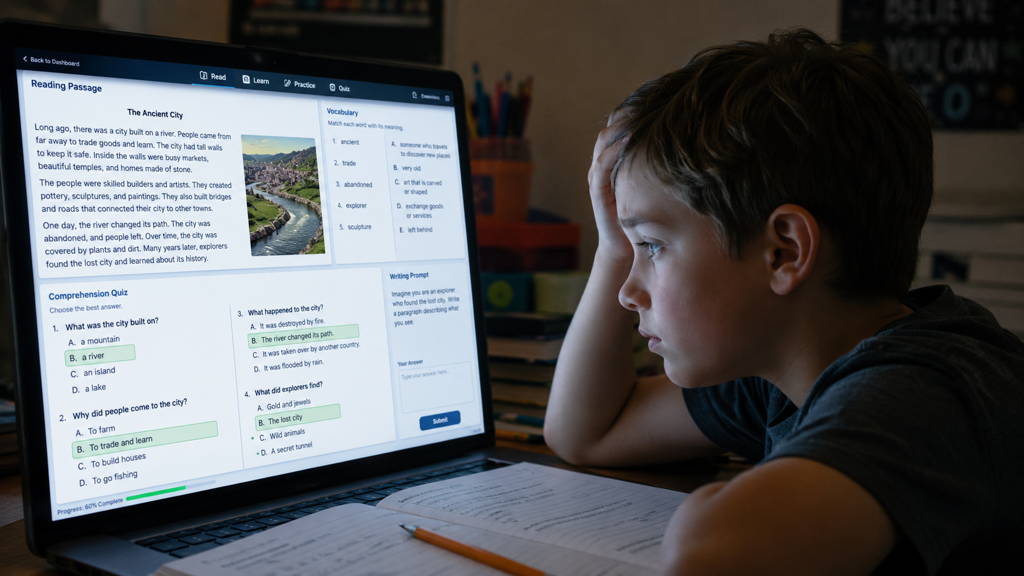
Many apps and online tools are designed to support diverse learners, and some can be helpful for access, practice, accommodations, and independence. Text-to-speech, audiobooks, speech-to-text, adaptive practice tools, and digital supports can all play an important role. But screens alone do not always provide what many learners need most: meaningful language use, repeated exposure, oral rehearsal, movement, tactile feedback, collaboration, and opportunities to connect words with real experiences.
For many learners, especially those who struggle with print, the most powerful supports are not only clicked or typed.They are also spoken, seen, touched, built, tested, revised, and explained.
Where multimodal learning helps
A well-designed project gives students a reason to use language.
Instead of reading only to complete a worksheet, students read because they need to solve a problem. They listen because a teammate has an idea. They speak because they need to explain a design choice. They reread because they need to check the challenge requirements. They write or draw because they need to plan, label, reflect, or present.
That shift matters. Students are no longer reading in isolation. They are reading as part of a larger process that includes thinking, building, testing, revising, and communicating. That kind of experience can be especially powerful for students who may struggle with print but are strong in oral language, creativity, reasoning, visual-spatial thinking, or hands-on problem-solving.
What we do at 3DuxDesign
At 3DuxDesign, our projects are designed with these diverse pathways in mind.
We are not a dyslexia intervention, and we do not replace Structured Literacy or specialized reading support. But we are a tool educators can use to help reinforce vocabulary, deepen comprehension, and capture more students through hands-on, visual, oral, and collaborative learning. The 3DuxDesign Zoo Challenge is one example. Students are hired as designers to reimagine a community zoo. They learn about animal needs, habitats, simple machines, visitor safety, and design. Students read short challenge sections, design solutions, build models, test ideas, and explain how their designs work.
The literacy support is not added as an afterthought. It is built into the experience.
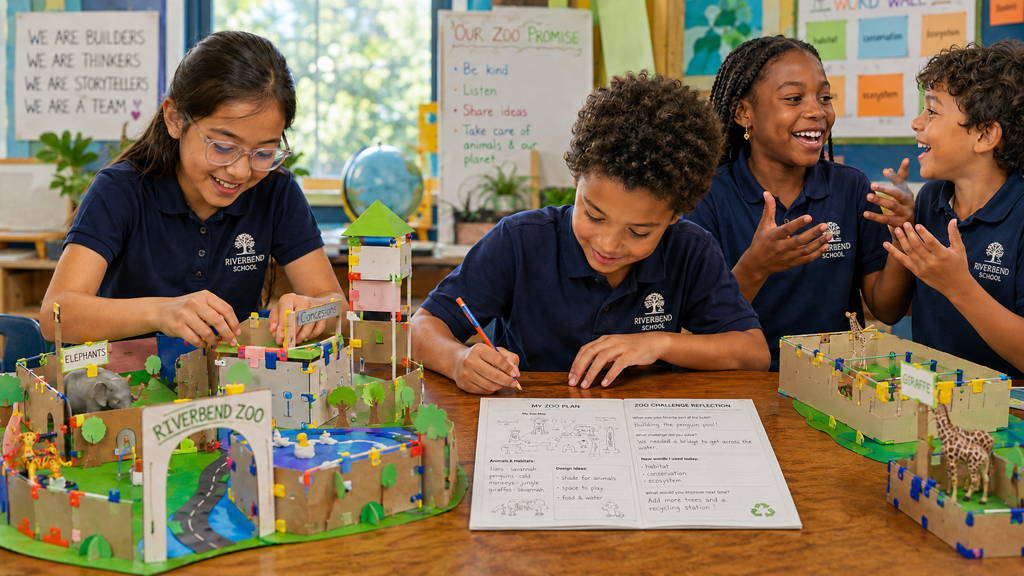
Four ways the 3DuxDesign Zoo Challenge supports diverse learners:
1. Repetition builds confidence. Each Zoo Challenge follows a familiar pattern:
Habitats and Fun Facts
Your Challenge
Need to Know
Design your solution
Build
The animal changes. The simple machine changes. The design problem changes. But the flow stays predictable. This can reduce cognitive load for students who struggle with reading because they begin to anticipate what comes next. It also creates meaningful opportunities to reread.
A student may return to the text to check what the animal needs, what simple machine must be included, or what problem the design is meant to solve. That kind of purposeful rereading can support confidence and fluency practice. Guided oral reading and repeated reading have been found to support reading achievement and fluency.
2. Multimodal learning creates more access points
Students are not relying on print alone. They read, listen, look at images and diagrams, sketch plans, build models, test mechanisms, and discuss solutions. In the elephant challenge, for example, students learn about pulleys through text, visuals, a diagram showing force and load, and a hands-on design task.
For a diverse learner, this can make the difference between memorizing a term and actually understanding it.
A pulley is no longer only a word in a paragraph. It is something a student can see, pull, test, and explain.
3. Oral language reinforces understanding
Many dyslexic learners have strong verbal reasoning. They may understand complex ideas more deeply when they can talk them through. The 3DuxDesign STEM Spy workbook builds oral language into the learning process. Students are asked to describe simple machines to others, use their own words, brainstorm with someone, and design a device to solve a real-world problem. This turns vocabulary into conversation and helps students practice academic language in a meaningful context.
A student might say:
“Our pulley helps lift the load.”
“The lever works because the fulcrum is in the middle.”
“We changed the slope of the ramp so the tiger could climb safely.”
“Our panda habitat includes a wheel and axle to help move toys.”
That kind of oral explanation supports vocabulary, sequencing, comprehension, and confidence.
4. Tactile design connects words to action
Words like pulley, lever, linkage, force, load, axle, and inclined plane become more meaningful when students can build, move, test, and explain them.
A lever is not just a diagram. It is something a student can balance.
A ramp is not just an inclined plane. It is something a student can adjust.
A linkage is not just a definition. It is something a student can move and observe.
The concept is no longer just a word on a page. It becomes something students can see, touch, revise, and share.
Students are not just memorizing words like lever, pulley, force, and load. They read, hear, build, test, and explain them — strengthening understanding by linking language to multiple pathways in the brain.
The goal: capture more students
3DuxDesign is not designed to replace reading instruction. It is designed to help more students access learning. For students who are already confident readers, projects like these deepen engagement and application. For students who struggle with reading, they offer additional pathways into the same rich content. When students can read, listen, talk, build, test, revise, and explain, they have more ways to show what they know. For diverse learners, including students with dyslexia, that matters.
Because the goal is not to make every student enter through the same doorway.
The goal is to build more doorways.