Cardboard Construction in the STEM Classroom:
Everything You Need to Know
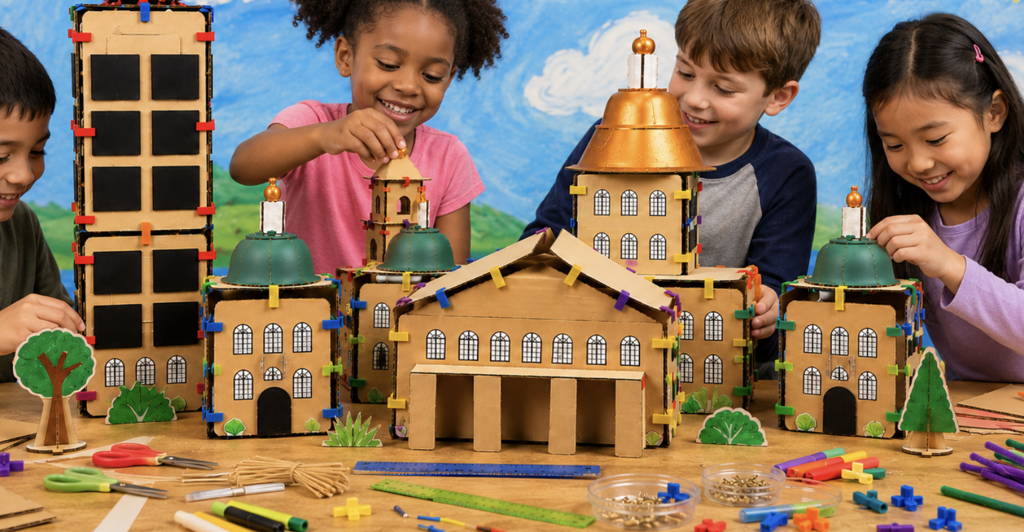
Cardboard may be one of the most useful materials in any classroom, STEM lab, library media center, makerspace, or afterschool program. It is easy to find, familiar to students, low-cost, recyclable, and endlessly flexible.
A single cardboard box can become a bridge, a tiny house, a habitat, a robot body, a city block, a simple machine, a landmark, a vehicle, a stage set, or a prototype for a brand-new invention. That is what makes cardboard construction so powerful for elementary and middle school STEM learning. It gives students a material they can transform quickly, creatively, and collaboratively.
Unlike kits that only lead to one final product, cardboard is open-ended. Students can make choices, solve problems, change direction, and keep improving their designs. That makes it a natural fit for project-based learning, engineering design, architecture, model making, sustainability lessons, literacy-based STEM, and creative problem-solving
Why Cardboard Works So Well for Hands-On Learning
Cardboard invites experimentation. Students can cut it, fold it, slot it, bend it, stack it, connect it, decorate it, and combine it with other materials. Because it is so accessible, students are often less afraid to take risks. If one idea does not work, they can try another.
That is exactly the mindset students need for STEM, design thinking, and creative problem-solving.
Cardboard also gives teachers an endless supply of raw material. Shipping boxes, cereal boxes, food packaging, and classroom recycling can all become part of the learning experience. This helps reduce material costs while also reinforcing sustainability, resourcefulness, and responsible use of materials.
Most importantly, cardboard construction is easy to connect to real academic goals across the curriculum. Students can explore measurement, geometry, scale, structure, forces, motion, simple machines, habitats, community design, storytelling, persuasive writing, civic problem-solving, and presentation skills. With the right tools and prompts, cardboard becomes much more than a craft material. It becomes a platform for meaningful hands-on learning in almost any classroom.
Why Cardboard Works So Well for STEM
Cardboard invites experimentation. Students can cut it, fold it, slot it, bend it, stack it, connect it, decorate it, and combine it with other materials. Because it is so accessible, students are often less afraid to take risks. If one idea does not work, they can try another.
That is exactly the mindset students need for STEM.
Cardboard also gives teachers an endless supply of raw material. Shipping boxes, cereal boxes, food packaging, and classroom recycling can all become part of the learning experience. This helps reduce material costs while also reinforcing sustainability and resourcefulness.
Most importantly, cardboard construction is easy to connect to real academic goals. Students can explore measurement, geometry, scale, structure, forces, motion, simple machines, habitats, community design, storytelling, and presentation skills. With the right tools and prompts, cardboard becomes much more than a craft material. It becomes a platform for meaningful hands-on learning.
Key Tool: 3DuxDesign for Fast Classroom Prototyping and Academic Tie-in
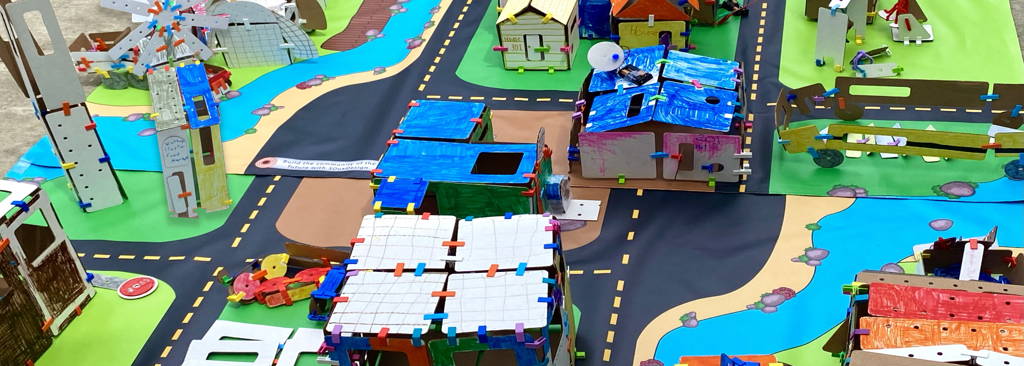
3DuxDesign cardboard modeling kits are designed for fast, flexible, classroom-friendly prototyping. The reusable connectors make it easy for students to turn flat cardboard into complex 3D shapes, architecture models, engineering prototypes, communities, habitats, and design challenges.
One of the biggest advantages of 3DuxDesign is speed. Students can connect pieces quickly, test an idea, take it apart, change the angle, and build again. That is especially helpful in a classroom where time is limited and students need to move through the engineering design process without waiting for glue to dry or struggling with rolls of tape.
The connectors are also useful for creating angles and stable 3D forms. Students can build walls, roofs, towers, bridges, ramps, rooms, enclosures, and more complex geometric structures. This makes 3DuxDesign especially strong for mini models and diorama-sized projects, where scale, detail, and structure matter.
The size is also highly manageable in the classroom. Students can build meaningful models without taking over the entire room. A tiny house, animal habitat, sustainable community, playground, landmark, or invention prototype can fit on a desk, table, tray, or project board.
3DuxDesign kits also include pre die-cut cardboard shapes with smooth, slightly crimped edges that are easy for students to handle. These shapes help younger learners, tactile learners, and students with developing fine motor skills get started quickly. Students can focus on designing, building, measuring, and explaining instead of spending the whole class period cutting basic shapes.
Another classroom advantage is cleanup. 3DuxDesign models can be dismantled in seconds, which makes them useful for fast-paced STEM projects, rotating makerspace stations, and one-class challenges. Students can preserve a project, revise it later, or take it apart and reuse the materials for a new idea.
Makedo for Larger Cardboard Builds
Makedo is another useful cardboard construction tool, especially for larger builds and end-to-end cardboard connections. While 3DuxDesign is especially strong for mini models, scaled prototypes, desk-sized builds, and classroom-friendly project-based learning, Makedo is often a good fit for bigger cardboard constructions.
One simple way to think about it is this: 3DuxDesign is great for dollhouse-sized, diorama-sized, and scaled model projects. Makedo is great when students are building larger, more life-sized cardboard structures.
Both tools can have a place in a STEM lab or makerspace. The best choice depends on the goal of the project. If students are designing small models with lots of detail, geometry, scale, and fast iteration, 3DuxDesign is a great fit. If students are building large forts, large-scale structures, or bigger cardboard installations, Makedo can be a useful addition.
ChompSaw for Cutting and Maker Tool Experiences
ChompSaw adds a different kind of value to a cardboard construction space. It helps students cut cardboard more easily and gives them the feeling of working with a real maker tool in a safer, kid-friendly format.
This can be especially exciting in a STEM lab, makerspace, or library media center because it expands what students can create from recycled cardboard. Instead of only using pre-cut pieces, students can make custom shapes, cut windows, create panels, adjust sizes, and modify cardboard to fit their ideas.
ChompSaw also adds a maker and construction feel to the learning environment. Students are not only assembling, they are fabricating. For older students or more tool-focused programs, that can be a powerful part of the experience.
Used together, these tools can support different phases of the design process. ChompSaw can help students create custom cardboard pieces. 3DuxDesign can help them connect, prototype, angle, revise, and build detailed models. Makedo can support larger-scale cardboard construction.
Basic Craft Tools That Add Big STEM Value
A strong cardboard construction area does not need to be complicated. Some of the most useful tools are simple, affordable craft and classroom materials. Together, these simple materials turn cardboard into a flexible engineering system.
Metal brads are excellent for linkages, moving parts, and simple machines. Students can use them to create levers, rotating parts, animal joints, doors, gates, wheels, and mechanical motion
• Straws are more than craft supplies. Their tubular structure can become an engineering lesson by itself. Students can compare how tubes, beams, and flat pieces behave differently when building towers, frames, supports, bridges, or lightweight structures.
• Pipe cleaners are surprisingly useful with corrugated cardboard. They can be inserted into the corrugation to create hinges, bends, flexible parts, gates, plant stems, animal features, handles, supports
Cardboard Connection Techniques Every STEM Teacher Should Know
Students can connect cardboard in many ways, and each method teaches something different. Some connections are fast. Some are strong. Some allow movement. Some make it easier to revise the design. Head over to the 3DuxDesign Tips and Tricks page to learn more about these techniques